Trainspotting
How to see what trains are passing near your house in the UK
A freight train rumbles past the garden. An express flashes through the station without stopping. You hear a locomotive that sounds different from the usual commuter trains. What was it, and where was it going?
To find out what trains are passing near your house, choose a nearby station or railway location, look up its detailed train times, then use a live railway map to follow approaching trains. The useful combination is knowing what is booked to run and checking what is actually moving.
You don’t need specialist equipment or much railway knowledge to get started.
This guide focuses on the mainline railway in England, Scotland and Wales. Coverage varies by location; the tools below should not be assumed to cover Northern Ireland, heritage railways, trams or underground networks.
In this guide
Which tool should you use?
Different tools answer slightly different questions.
| What you want to know | Where to start |
|---|---|
| What is booked to pass a nearby station? | Realtime Trains’ detailed search |
| Where are trains moving right now? | Traksy or OpenTrainTimes’ live maps |
| When might there be an interesting mix of trains to watch? | Lineside Spotter |
| What is approaching, without opening a website each time? | The Lineside Ink display |
Start with a train list and a live map. Once you have found the right location, save them so you can return quickly.
1. Find the railway location closest to your view
Most railway tools work with stations, junctions and other named railway locations. Your house won’t usually be a searchable point.
Open a normal street map and follow the railway past your home until you reach a station. Check that it is on the same stretch of track you can see. The nearest station by road might be on another line.
If your home is between two stations, make a note of both. Each can be useful for following trains approaching from its direction.
Pay particular attention to junctions. A train heading towards a nearby station might turn onto another route before reaching your house. Equally, a train could join your line after passing a station you have been watching.
Treat times for your chosen station as a reference point. A train will pass your home before or after that time, depending on its direction. There is no fixed adjustment that works for every train: speeds, stops and signals all affect the gap.
2. Look up passing trains with Realtime Trains
Realtime Trains offers a detailed view that includes freight and empty passenger trains as well as passenger services.
To get started:
- Open Detailed Search.
- Enter your nearby station or railway location.
- Choose today’s date and a time around now.
- Include passenger and non-passenger services.
- Open a service to inspect its route and timings.
Look for trains shown as passing, as well as those arriving or departing. An express that doesn’t stop can still be one of the trains you see from home.
When reading the timings, distinguish between:
- Booked times: when the timetable says the train should be there.
- Estimated times: when it is currently expected.
- Actual reports: evidence that it has reached or passed a reporting point.
A timetable entry tells you what is planned. Recent actual reports are much more useful when deciding whether a particular train is on its way.
3. Follow approaching trains on a live map
For a view of the railway around you, try Traksy or OpenTrainTimes.
Search for your station and open a map covering the area. These are diagrams of railway tracks and signals, so they look different from a street map. Use the station names and junctions to orient yourself.
You will see short codes in boxes along the tracks. Many are headcodes, such as 1A23: codes used to identify train services. A headcode is different from the number painted on the locomotive or carriage.
Where the site can match a code to a service, selecting it reveals timetable information. This helps connect a moving train with its origin, destination and route.
Watch a code move through successive positions to get a feel for its direction. If the line branches before your house, check the route rather than assuming every approaching train will pass you.
These maps use signalling information. A code stepping along a diagram is not a continuous GPS position, and gaps in coverage or reporting can leave trains missing or apparently stationary. OpenTrainTimes explains how its diagrams work here.
4. Check whether that freight train is actually running
Freight can be one of the most interesting parts of living near a railway, but it needs a little more interpretation.
A freight service appearing in the timetable does not guarantee that it will run. Some services operate only when required. Even a service marked as activated may not actually depart.
Check for recent actual movement reports along its route, then look for it on a live map where coverage is available. Realtime Trains’ help page explains why activation alone is not proof that a freight train is running.
Freight identities can also be obscured in the public data, so a code may not match neatly between websites. Sometimes you can see a train moving without being able to establish all its details.
It is fine to leave a train unidentified when the available information does not support a confident match.
5. Find a good time to watch with Lineside Spotter
If you want to spend half an hour watching the railway, Lineside Spotter helps you explore the expected activity at a location.
Search for a nearby station to see booked movements, the expected passenger and freight mix, and periods that might offer more variety.
This is useful for choosing a time to look out, especially if you are watching with children or hoping for something beyond the usual passenger services.
Spotter’s timetable pages show what is expected, not a record of trains observed. Suggested train types are inferred from planning data and can change. Use the timetable to choose a promising period, then check live running information nearer the time.
How to identify a train that has just passed
If you missed the chance to check beforehand, note the time, direction and anything distinctive: the operator’s colours, a locomotive hauling containers, or passenger carriages travelling empty.
Then open the detailed train list for a nearby location and look around the time you saw it.
Allow for the distance between that location and your home. A train that passed your window at 14:10 might have passed the station several minutes earlier, or might not reach it until later.
Compare the actual timings and route with what you observed. On a busy line, more than one service may fit, so avoid choosing solely because its booked time looks close.
Finding the service does not always identify the exact locomotive or unit. Realtime Trains shows allocation information for supported services, but that detail is not available for every train.
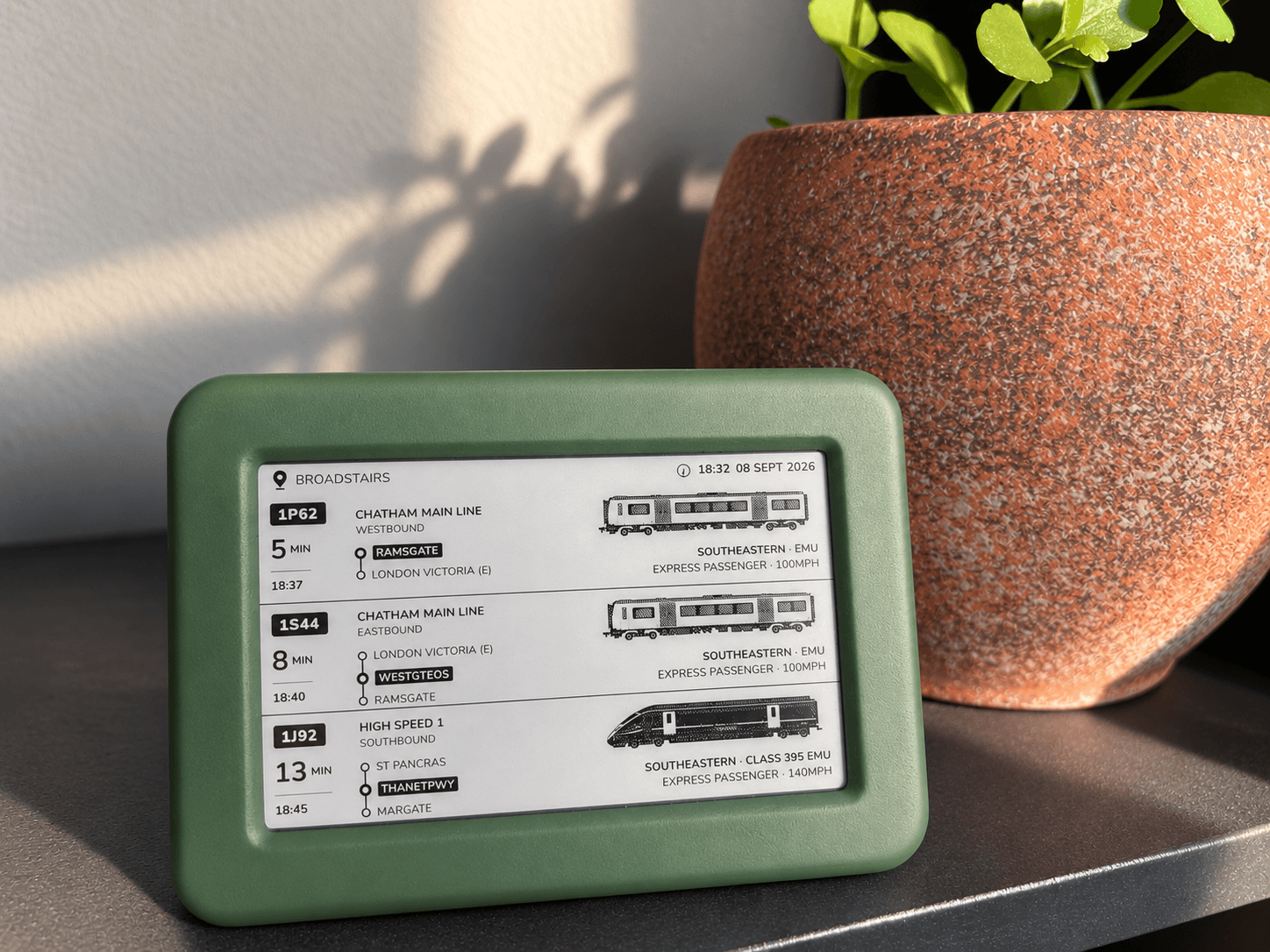
Our own creation
See approaching trains without opening your phone
I built Lineside Ink because my children enjoyed watching the trains near our home, and I wanted us to see what was coming with a glance.
Lineside Ink is an e-paper display that follows a railway location you choose. It uses live railway movements to show approaching trains, including freight and passenger services passing straight through, where the data is available.
Once connected to your home Wi-Fi, it updates on its own. You can keep it on a desk, shelf or windowsill and look over when you want to know what is coming.
The predictions refer to your selected railway location, so the same before-or-after adjustment applies when watching from home.
If you are just getting started, look up your local station in Lineside Spotter, then open a live map alongside it. The next train you notice may come with a little more of its story.